-compressed.jpg)

Daily, snackable writings to spur changes in thinking.
Building a blueprint for a better brain by tinkering with the code.
subscribe
rss Feeds
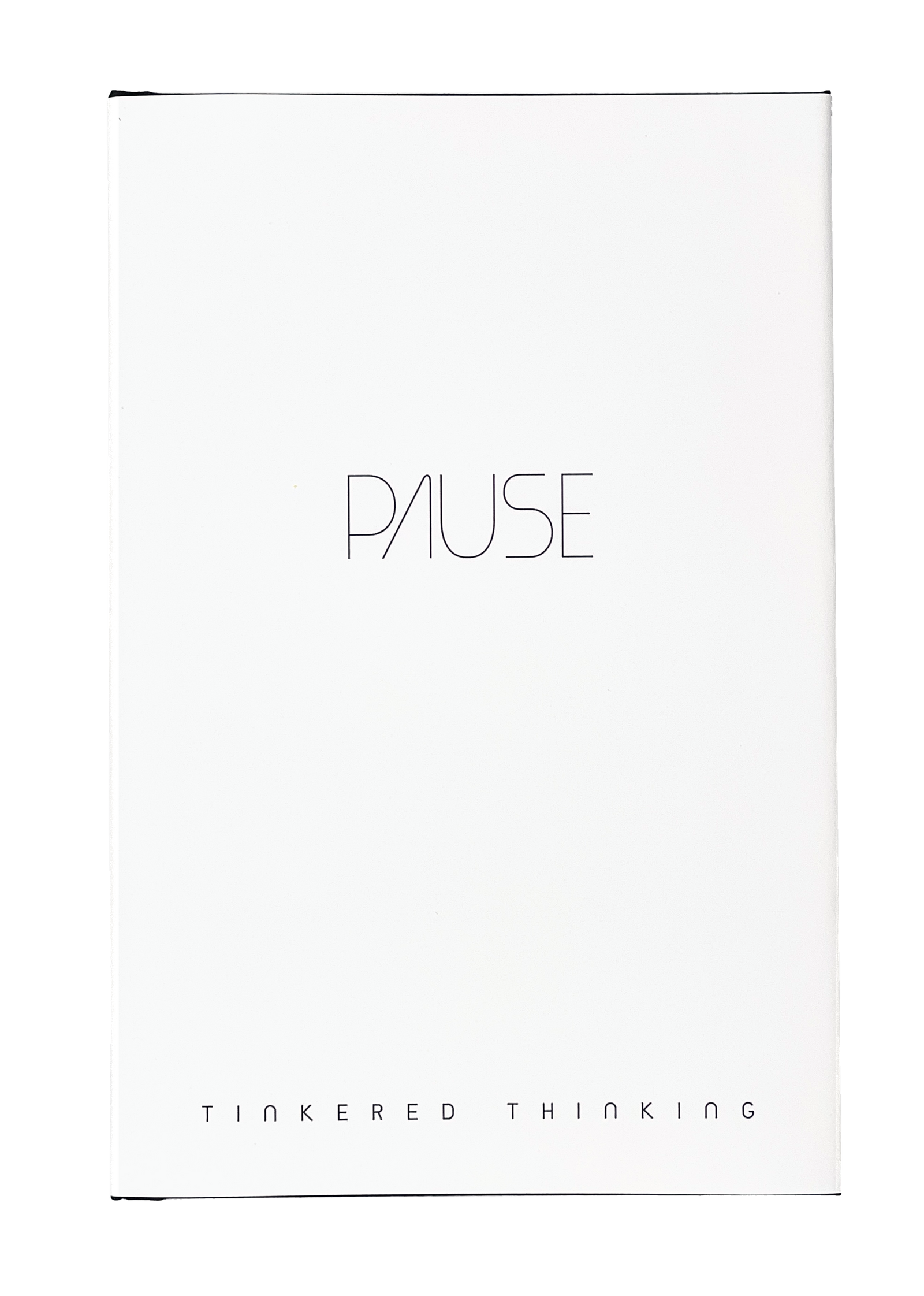
The first non-fiction book from Tinkered Thinking. PAUSE is a short book on meditation. Now available on the Tinkered Thinking Bookstore.
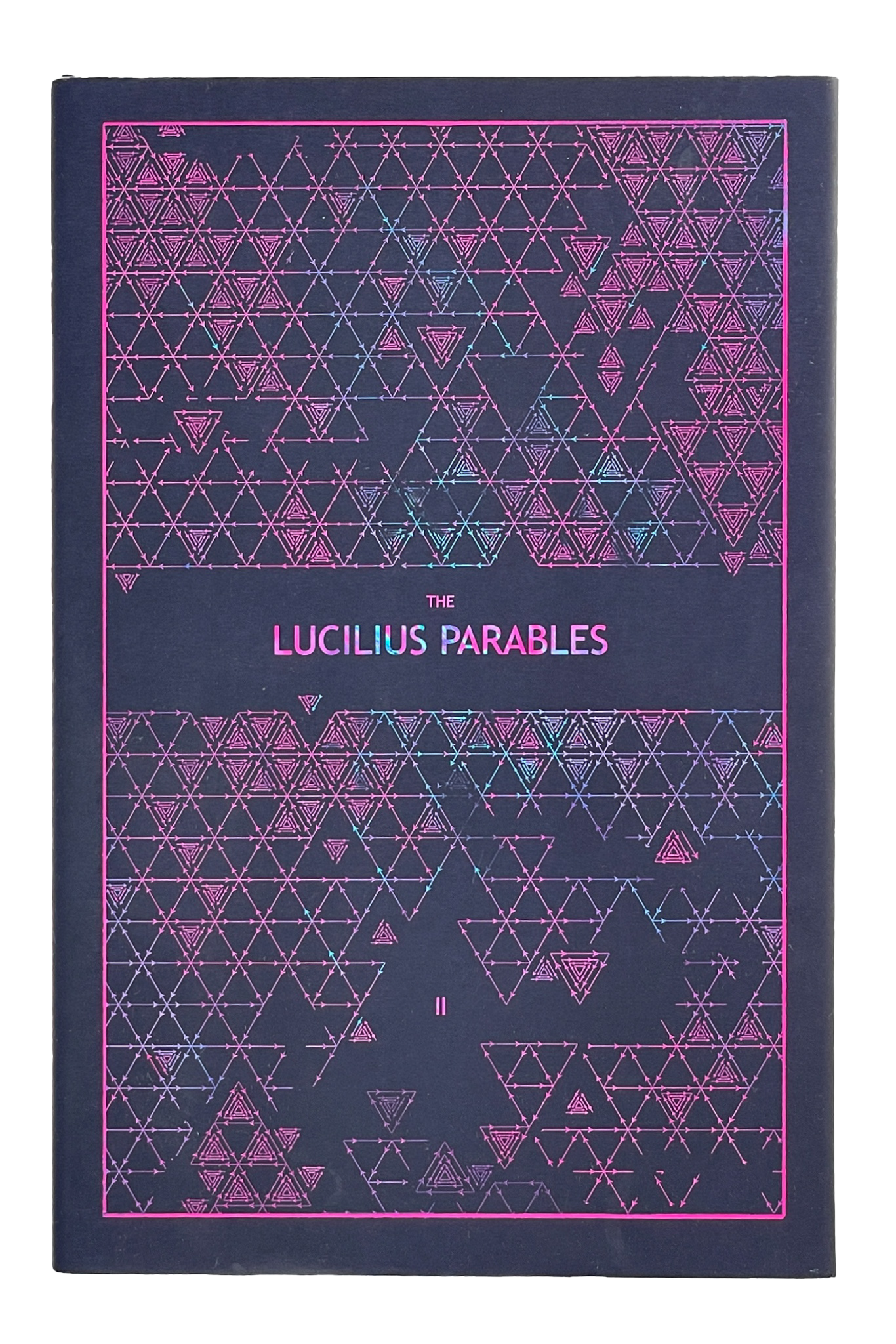
The SECOND illustrated book from Tinkered Thinking is now available!

SPIN CHESS
A Chess app from Tinkered Thinking featuring a variant of chess that bridges all skill levels!

REPAUSE
A meditation app is forthcoming. Stay Tuned.




PYSCHOLOGICAL STAND-OFF
May 4th, 2021
The equation for procrastination is often as follows: there exist two things, the one you want to do, and the one you should do. Doing what you want to do without first doing what you should do decreases the enjoyment. Any activity is more enjoyable in the absence of some lingering stress, and those activities that are purely for enjoyment are undermined. But instead of doing what we should do, we often go for a third option: some innocuous chore that has no pressing obligation. Or worse yet: we do nothing, paralyzed, locked by the binary options.
It’s at this point that a large portion of the local bookstore steps in, taking the form of the ‘self-help’ section. The very best of this entire literature boils down to: just do the thing that needs to be done. It’s almost the correct advice. For some it works, and for those they may shake their heads at the rest of the paralyzed bunch, not without an air of superiority. Better advice is just a smaller version: just start.
Just as Rome wasn’t built in a day, most goals and projects are accomplished through a kind of attrition. We slowly wear down the to-do list of large projects. They are never done in one giant swoop of effort. And if they are, perhaps projects of a bit larger magnitude are in order.
DOWNSTREAM PURPOSE
May 3rd, 2021
We are good with one - to - one correlations, especially when it comes to our actions and the effects they have. Got to work, get a pay check. Have a drink, feel good. Take a pill, relieve the anxiety. We are remarkably untalented when it comes to second and third order effects of our actions and retooling what we do initially to tweak those results.
Maturity and self awareness might be as simple as realizing that there are far more things that we can do on purpose. No one wakes up exhausted on purpose. No one feels anxious on purpose, and no one wastes a life doing the same menial job that they hate on purpose. These effects are all downstream, and it requires a good deal of self-understanding, planning, and even a little bit of cleverness to take action in the name of such late-order effects.
What’s first required is simply being able to see relationships among things that expand beyond initial one - to - one correlations. For example, thinking about the potential hangover when contemplating the idea of having a drink. For anyone that drinks quite regularly, this is even more difficult because there’s often no longer a hangover to be worried about. At that point its a matter of understanding from an intellectual standpoint that the entire experience of life might be dampened, and that this has gone on for so long that it’s simply not possible to imagine a higher baseline. What feels ‘normal’ can be depressingly subversive in the face of any attempt to see connections between what we do, and how we perpetuate the problems in our lives.
Drinking coffee is another example that fits into the issue of chronic exhaustion. While it advertises and often feels like the cure to low energy, a chronic overuse of coffee will actually exasperate the problem. Coffee and alcohol become easily and smoothly linked up. The hangover seems easily solved by a deluge of coffee and then later in the day, the anxiety caused by chronic coffee used seems easily solved by just having a drink or two in order to unwind.
Vicious cycles chain together and multiply in effect. Such a habit leads to a lower baseline and an obliviousness to it. Such exhaustion and stress leave little resource left over for thinking carefully through very large and important aspects of life, like that menial job that is anything but fulfilling. The downstream effects of our actions become particularly tricky to see and plan for. And then with enough vicious cycles chained together, life can become a continuous trap that is constantly rolling in a worse direction.
Shaking up one’s life, the way moving, or extended travel can, is one of the easiest ways to see things differently. When our habitual patterns are interrupted and downstream effects change accordingly, that dissonance is easier to notice, analyze and understand. Otherwise, in order to see such puzzle pieces connected at a distance requires a good deal of intellectual imagination. It requires ingesting certain pieces of knowledge, imaginatively understanding how they interact, and then creatively construction a hypothesis about how things would be different if certain variables were changed. But of course, the exhausted imagination is far less equipped to handle this task in a way that has an effect that is emotionally convincing to the point where someone might actually try and change.
A LUCILIUS PARABLE: LIFETIME OF ENTERTAINMENT
May 2nd, 2021
As the aisle tilted to reveal itself, as Lucilius slowly walked, the horns swelled to a crescendo in concert with the thundering drums. Lucilius slowed to gaze down the aisle, wondering if his needs were down this way or that. The soundtrack crashing into his mind through earbuds grasping and twisting his attention in designed ways. He walked on, and no thought interrupted his experience as he savoured the simple steps and sight in the fluorescent environment of another ordinary grocery store.
He knew this was all being recorded, but he never thought of it - by design. He knew that countless people would feel the weight of his own feet as they each took their steps, see his gaze wonder across the shelves of cooled products. And when he was done shopping for dinner they would gaze up at the twilight sky with him. They would marvel at the towering trees he took time to look up at. They would hear the music he had picked, they would know it all.
Lucilius’ extensive practice of meditation had perversely prepared him more than most for the an advanced technological era. Having emerged from a long seclusion that lasted decades, Lucilius had found a people - a world - totally enmeshed with it’s electronics, and at first Lucilius even had trouble communicating with people in the most basic way, split as they were between so many different portals of attention.
It had been a nervous reintroduction to the world. He’d taken such hiatus’s before, but this time the world had crossed some sort of inflection point. Whereas before he could leave the world and come back to much the same, this time, things were radically different. His previous finances barely carried any value in the new world, with it’s new currencies, and little memory of the old systems. He found himself sitting in an immaculate and beautiful city park, empty of people, but perfect in Lucilius’s eyes, when he found a stray pair of old glasses and tried them on out of childish boredom more than any deliberate thought. They revealed an augmented reality, cluttered with ads and art. He gaped in awe at the overlay on the world all around him.
And then it was one ad in particular that his attention circled in upon.
“MeTube”
Apparently humanity had given birth to it’s long awaited artificial intelligence, and the consciousness that now organized the world’s ways informed humanity that it had quite a long time before the answers of the universe could be unravelled. It was just a matter of computation now, and that meant, in the meantime, there was entertainment to be had, to be invented, perfected, and shared among the great family of people while they all waited for the grand computer to calculate.
Lucilius didn’t know it at the time, but the global artificial intelligence had noticed Lucilius’ return and endeavoured to wonder whether Lucilius might help his fellow man and woman with his talents, knowing his curiously long past and his abilities. It had planted the glasses in the park with the express purpose of flashing the ad that Lucilius now found himself waving at in a vain effort to discover more about this ‘MeTube’.
In no time at all Lucilius became one of the top creators on ‘MeTube’. It was a platform where people could experience entire lifetimes, designed - that is, lived first by someone else with a talent for living. Lucilius’ long practice in the art of attention had formed an unexpected training for this new medium. With simulation technology, time could be condensed, and Lucilius could live and record several full lifetimes in the course of a single day, though he and everyone else experienced them as centuries. Other people then rented the entire experience, the entire lifetime, as a form of entertainment, and even, an education. It unexpectedly functioned as a kind of growth for others to experience these whole lifetimes, like an excellent and life changing movie, but one that expanded for many decades and wrapped around every sense down to the point where a viewer had no recollection of their real person - they experienced life as Lucilius did, his attention becoming their attention, their sense of heat and cold, of pain and pleasure, of comfort and horror, all his own, becoming theirs for a century snuggly fitted into an afternoon.
Where the lives of normal people were filled with endless looping anxieties and a total obscuration of surroundings, the recorded lives of Lucilius gave people’s minds a training in the relief of what it mean to simply exist and live.
It wasn’t hard for Lucilius. He was simply himself, in these new situations, these new lives, these simulations. All his viewers experienced every moment as he did.
It was an art of attention for Lucilius that was highlighted by some of life’s simplest details: Looking back every time after saying good bye to see that friend or lover or colleague walking away. He always took the time to stop and enjoy some vagrancy of light or movement, crafting the flow and shape of his own attention like a cinematographer. But more than anything, what attracted people to come back time and again to Lucilius’ channel on MeTube, was the way he dealt with death and sadness. Where so many knew their own tendency to cramp up, deny and ignore, it was a relief to experience such terrifying things the way Lucilius did. He was unafraid. Be it the death of a parent in this life, or the bitter parting with a lover in the next, Lucilius never shied away from what was happening. He laid himself bare, always, and it was this experience, this complete surrender and vulnerability that people learned from the most. In an almost obsessive way, people gravitated toward the ‘Lives of Lucilius ‘ (as his channel was called) as a kind of intense training for their own life in the real world.
It wasn’t long at all before Lucilius had amassed quite a fortune, and after exploring the new world his human family had created, he was content, and decided to take another hiatus, retiring to a cave, now on a new planet, just to spend some time with himself and meditate for, perhaps, a few more centuries.
BENEVOLENT SUBVERSION
May 1st, 2021
A statement wears it’s meaning on it’s face, a question, on the other hand, is far more subversive, because, where exactly does the meaning of a question exist? The question, as a concept and as a tool is a kind of Trojan Horse of communication, slipping past defences, right into the core of another person’s mind where it then takes on it’s true form.
The meaning of a question gathers itself from the contents of the mind it enters. The question provokes the mind it enters toward a certain, and often unique expression. While a certain variety of questions are pretty much answered the same across the board, like: what’s the color of the clear sky? Other questions evoke exquisite uniqueness.
Consider for example the token cocktail party question: what do you do for work?
This is an exceptionally boring question. But it’s useful for understanding the utility and function of questions. It’s meaning isn’t actually present in it’s form. The meaning of the question is locked within the mind of the person it’s directed towards. This is the entire point of a question. It’s a puzzle designed to retrieve a specific piece of information from another mind.
Pause for a moment to reflect on how crazy that concept is, and the fact that animals either cannot or simply do not form questions. (Yes, there have been extremely simplistic instances where it seems an animal has asked a question, but there is an important distinction to be made between a request for information and a genuine question where the answer is unknown without further action.)
Take for further example an unexpected question at a cocktail party. What if, instead of asking you what you do for a living, someone asked you how you ensure you’re living a fulfilling life?
This sort of question would most probably stop most people in their mental tracks with the realization that this is an important perspective that has perhaps never been fully considered before. And this is startling because it’s such an important question, but one rarely -if ever- asked.
Notice further that a question about fulfillment does not necessarily have the same straight forward answer that “what do you do for a living?” has. People may certainly have a whole variety of answers, and even a single person might answer when a complex web of psychologically relevant aspects of living.
The question reveals its most important utility in the way that we bridge and share perspectives. This is an old concept, known as “Socratic Dialogue”. Socrates was the teacher and mentor of Plato who apparently recorded his ideas. The Socratic Dialogue is a way of convincing someone of a certain point of view by leading a person to that point of view with a series of questions. Socrates would use the material of another person’s mind as the fodder for constructing the path that leads to his own perspective. Consider how apt the question is for this utility given some previous description here. It unravels in the mind that hears it and gathers it’s meaning and answer from that imagination. Using questions artfully and carefully, a person can make a person convince themselves of your own point of view.
This is, of course, a delicate art, more akin to dancing since that’s what you’re doing with another mind when you ask it a question. There isn’t really any knowing just how another mind will react to a specific question until you ask it and find out.
One way to illicit the power and utility of the question is to think of it literally in a physical space. Say, for example, you are facing a person, and you can see a portrait of Van Gogh behind them.
Now, given this situation, what is the best way to convince this person that there’s a portrait of Van Gogh behind them? We can simply make a statement, like: ‘there is a portrait of Van Gogh behind you.’, and if this person finds us trustworthy, then they might believe it. But again, this requires trust, and good bit of imagination.
We can, instead, ask: what is behind you? The answer and meaning of the question is not present in the question. It’s a puzzle that sparks a bit of curiosity and impels the person to turn around. The answer of course doesn’t rely on trust or imagination. It’s a direct perspective, and nothing is more convincing.
MENTAL HYGGE
April 30th, 2021
In Danish and Norwedgian cultures there is a concept called ‘Hygge’, pronounced ‘who-glee’. It refers to the measure of coziness and comfortable conviviality that any given space has. For example, your favourite coffee shop probably has excellent Hygge, while a hospital with it’s sterile, fluorescent environment lacks pretty much any positive measure on this spectrum.
Many cultures outside of Scandinavia could benefit greatly from a consideration of Hygge. North America is certainly one of them. But beyond this, the external world we create probably reflects to a good deal our internal mental world. There is something ironic about considering something like Hygge in the first place is likely indicative of positive mental health.
Many people can notice this on a small individual scale. We often procrastinate by tidying up, but once the tidying is actually done, the mental space as influenced by the actual physical space is a bit more positive. Hygge in terms of the design, layout and ambiance of an entire room or house just takes this to a whole new level.
As an aside, we might wonder how much more benefit the mentally ill would experience if mental institutions were designed to be incredibly cozy, as opposed to something like a hospital or a prison.
But regardless of the physical space where we might find ourselves, applying the concept of Hygge to one’s own mind yields an interesting question: Is it comfortable and cozy to be in your mind? To be in your skin? To be you?
This is a bit like the opposite of anxiety, and it’s interesting that we don’t really have an explicit antonym for anxiety. Is it relaxed? Or happy? Content? Or Fulfilled? All of these are slightly different aspects that are actually quite transient. We can’t feel any of them all the time, and yet there must be some sort of quality of mind the persists across all these transient states. Is that quality a cozy one? Or do you have some redesigning to do?