Coming soon

Daily, snackable writings to spur changes in thinking.

Building a blueprint for a better brain by tinkering with the code.

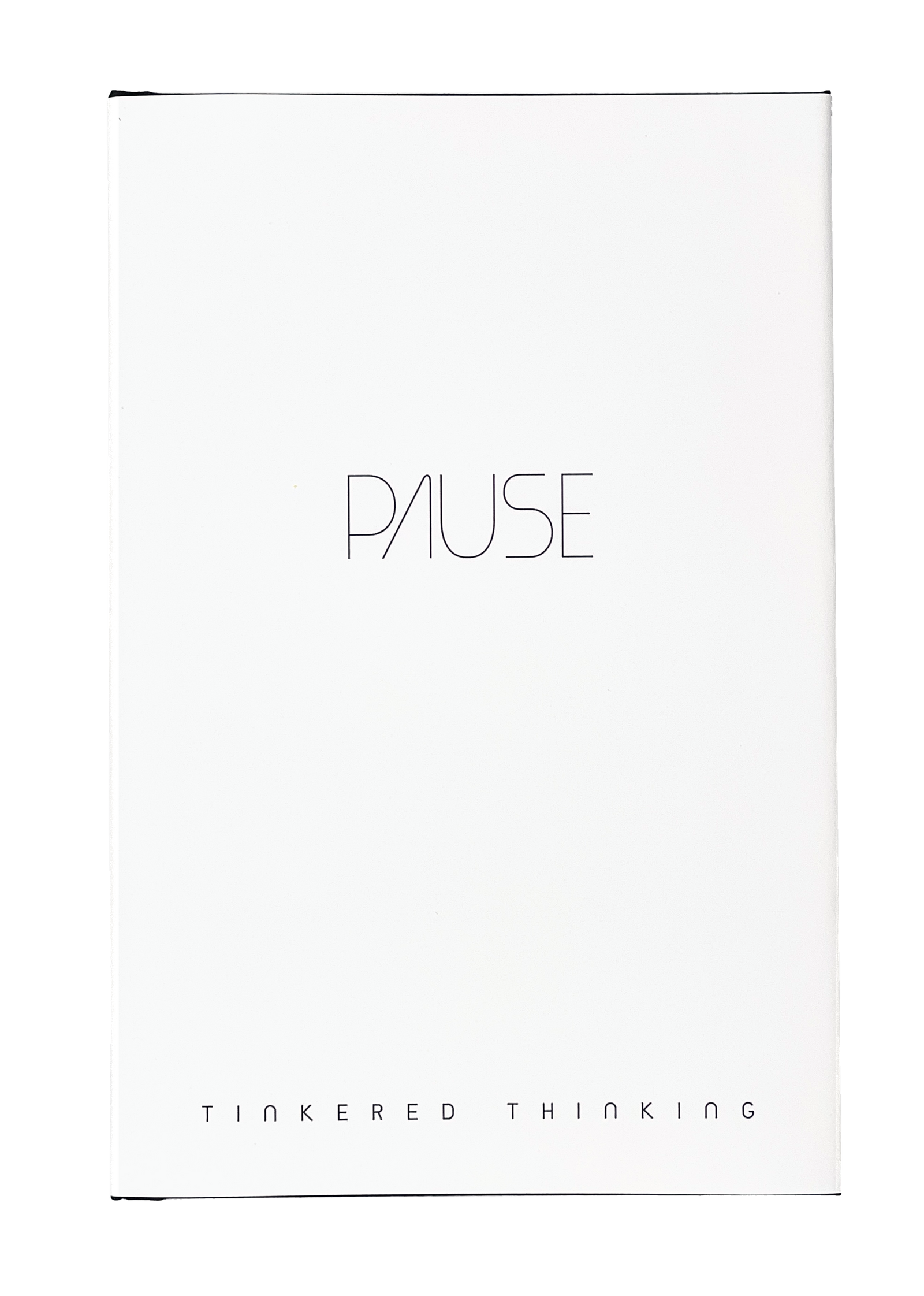
PAUSE

The first non-fiction book from Tinkered Thinking. PAUSE is a short book on meditation. Now available on the Tinkered Thinking Bookstore.
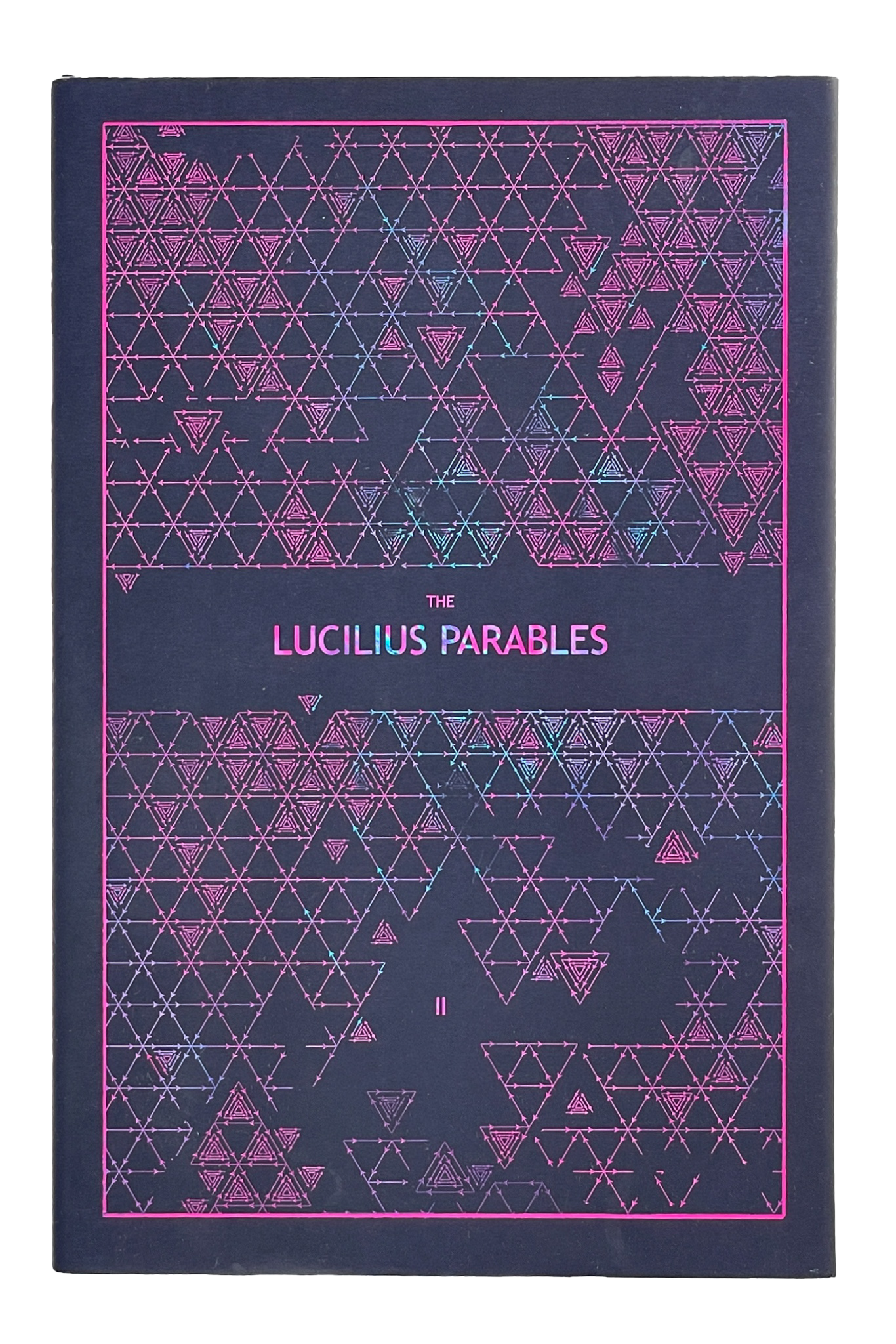
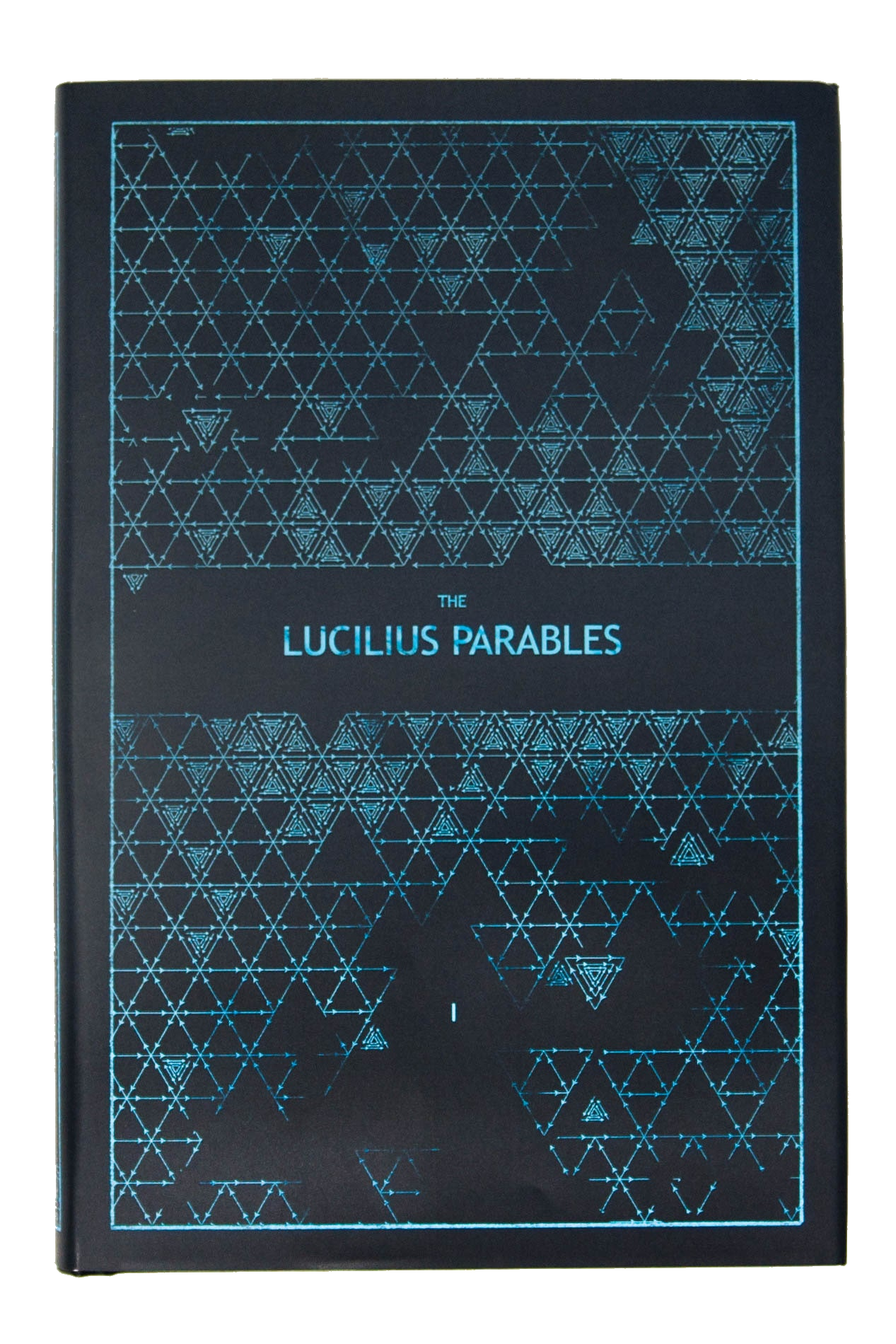
The SECOND illustrated book from Tinkered Thinking is now available!

SPIN CHESS

A Chess app from Tinkered Thinking featuring a variant of chess that bridges all skill levels!
REPAUSE

A meditation app is forthcoming. Stay Tuned.

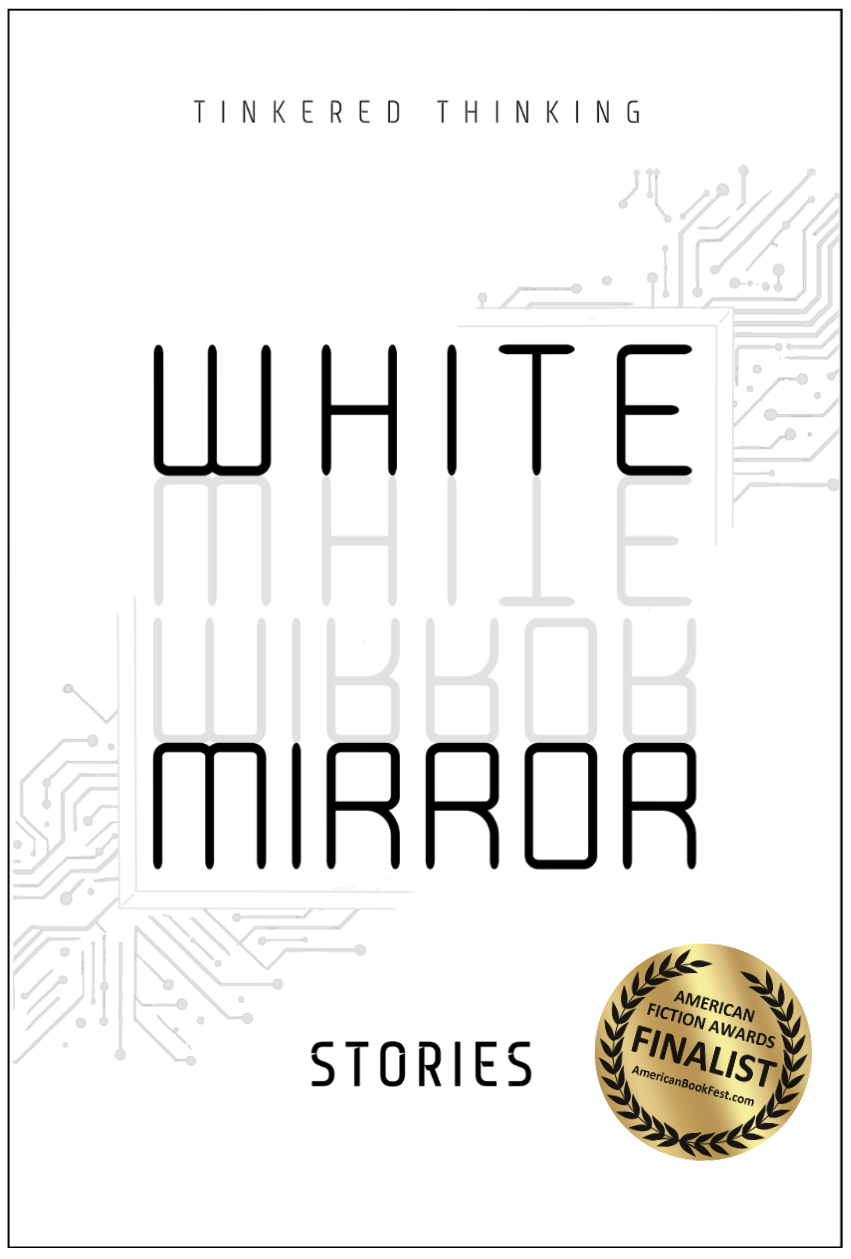
WHITE MIRROR IS AN AMERICAN BOOK AWARDS FINALIST!

August 4th, 2026
The title says it all. 
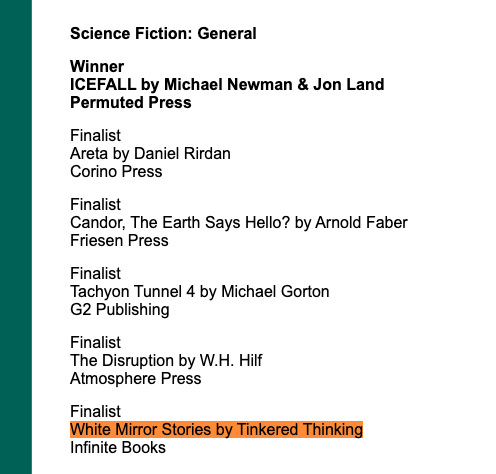
Yesterday I was notified that my book WHITE MIRROR, published through Infinite Books was a Finalist in the American Fiction Awards for Science Fiction!

Now, one important note: the Finalists are listed in alphabetical order — there is no implied hierarchy. I know, it's a little petty, but I was curious. So it's basically a five-way tie for second place. Which, you know what? I'm thrilled about it.


Because frankly, my expectations were extremely low. When my publisher told me they were going to submit it to a small selection of awards, I said cool but I had zero real sense that White Mirror would come close to winning anything. 


Don't get me wrong. It's not because I don't think the writing and the stories are good enough. As a finished book, I'm very proud of it. I think it has a lot to offer. But it is an unusual book. First, it's written under the pseudonym Tinkered Thinking. I assumed somewhat that this would be a ding against my odds simply because it's unusual in a way that is reminiscent of online trolls and catfish. Second, it's an evolution from The Lucilius Parables, which already has an unusual set of constraints: the same character, an admittedly flat character, and it's devoid of your usual recipe for drama.


Perhaps the most interesting part of my reaction to this fantastic news was the thought that followed up the initial emotional excitement like a caboose on a long leash: well shit... White Mirror is GOOD, but like... I can do better...


So it makes me think about the dozen-plus chapters that I have written of a novel. The shame is that a novel requires big long blocks of time, and those just don't fit into my life very well right now. Essays and short stories — I can bust those out in an hour and be pleased for what they are. But a novel is a big, complex, organic monster that requires time to get into the flow with. Or, at least, that's been my sense of it as I work on it.


Regardless, WHITE MIRROR as a finalist. That's pretty cool. And my publisher says we can now put a shiny gold sticker on the front of the book now. And, who doesn't like a gold sticker for a job well done?


AN OPEN LETTER TO A READER WHO STOPPED AT THE COPYRIGHT PAGE

September 4th, 2026
Hello! I am the author of White Mirror. It's a bummer you didn't finish the book, and perhaps an even bigger bummer to leave a review for a book that you didn't fully read. Given your scruples I can understand why you would write this. It seems like you are trying to warn others of some kind of dishonesty or hidden toxin. 

Regardless, I think there's a few things you might find interesting. Believe it or not, I used to be an art teacher. I was classically trained in figure drawing, figure painting, plein air painting, draftsmanship and sculpture. My two teachers were enormously important to me and they had a profound impact on who I am as a person, artist and writer. After I went through my years of apprenticeship, they asked me to join the school as a teacher, which I was honored to do. I've since worked as a teacher in several capacities but that time teaching kids how to draw, to paint, to look at the world and express it through their new found skills... those memories are incredibly precious to me, and it continues to inform how I look at the world today. 

I learned about Raphael, who was basically like the original Andy Warhol and built and ran the first printing operation with a deliberate distribution channel1. But he wasn't criticized by his peers. (The idea that reproduction cheapens art was itself a much later invention) And I learned about the strangely accurate paintings of Vermeer, who almost certainly used some type of Camera Obscura to basically *trace* a projected image of his painting's subject. (There's a really good documentary about a delightfully unhinged guy who basically recreated the entire theorized process to make a Vermeer painting for himself, and the results were incredible. It's called Tim's Vermeer (2013), I highly recommend it!) And I realized that artists are tool-users. A paintbrush is a tool, a pen is a tool, a chunk of charcoal is a tool.

For my first two books (self-published on the Tinkered Thinking Bookstore) The Lucilius Parables Volume I and Volume II, I did all of the illustrations (about 80) myself by hand. I have the skills and my stories are short and I thought it would be a nice little bit of eye candy for the reader to start the stories with. I have enough stories to put out a third volume and a fourth. The bottleneck is the illustrations. They take a **long** time, hence why I haven't been able to get those volumes out, despite the fact that the stories have been written for a long time. 

After my start as a visual artist and a teacher, my artistic sensibilities eventually landed on writing, and I eventually wrote a few hundred short stories. (All of which can be read on the blog Tinkered Thinking, along with about 1,000 essays on various topics. All of it is exclusively rough draft form, nothing is edited or cleaned up so beware of the all-too-human artifacts that come with such drafts) And to be sure, I used to be quite a luddite. Before I started Tinkered Thinking, I wrote fiction exclusively on an old typewriter (a Smith & Corona from 1932, which I lovingly repaired and maintained). Eventually I had a bit of a break with my nostalgic outlook on things. Gave up writing for a bit and started reading on topics that I'd formerly ignored. I eventually taught myself how to code (pre-AI) and started building products, which I discovered was just another type of artistic medium. As part of a coding exercise I built a blog, and I'd started writing again, so decided on a whim to populate the blog with my writing. I had no intention of actually starting a blog/podcast but it unfurled organically. 

I started thinking a lot about technology in these little essays that I was posting. I didn't really care if anyone read it, I just liked the aesthetics of the little website I'd built (it felt like an art project) and unlike so many bloggers and *writers* I actually really enjoy playing around with words and ideas. I'm not precious about it. It's just fun to watch my thinking manifest right in front of my eyes. To see my thoughts. It's been an incredibly important practice for me. I realized that a computer keyboard isn't that different from a typewriter.2​ (Though there are differences and in some ways I prefer the impracticality of a typewriter — forces you to commit, stay with what you've written. No erasing) And a typewriter isn't that much different from a pen or pencil, and a pen or pencil, or a stylus cut from reeds growing on the banks of the Tigris and Euphrates, used to press cuneiform shapes into clay tablets. They are all related tools, or technologies that grow from one another. 

I started to see everything as tools. The bag that I carry my stuff in is a type of tools. And most of the stuff in the bag — it's just a collection of tools, be it an ipad for drawing, a laptop for coding and writing, or even something as humble as a piece of paper to take some notes on. Even words are tools. I think language itself is the most powerful tool that humans have. (whether we invented language is a totally different conversation which I've written about on my blog quite a few times.) 

And then AI came along. One of the first interesting things was what Stable Diffusion released, which was an image generation model. Being a visual artist myself, I was curious, so I played around with it and had a lot of fun. I even took **my own art** and trained a custom fine-tuned model on my own artwork. I wanted to see if I could get it to create images in the same style that I like to create. I posted the results on twitter with pairs: one handdrawn by me, and one produced from the custom model I'd trained on my art. The results were impressive and not a single person was able to guess all of the pairs correctly. Again, I was having fun, which I think is a very important part of creativity and artistic expression. 

I was lucky enough to get a book deal from Infinite Books based on the strength of my many short stories on my blog. I'd already written many 'white mirror' stories, so it felt very natural to simply continue in that very niche sub-genre of optimistic sci-fi. Infinite Books was an amazing publisher. Not only was I given an enormous amount of creative freedom, but I was paired with a tremendous editor, Dylan O'Sullivan who worked with me one-on-one for over a year to really dial in the language and the stories. The book is as good as it is in large part to his genius, and I am forever grateful. 

When it came to the illustrations, I wanted to do something unique, something a bit different than what anyone had ever done before. Given the subject matter of the stories, I felt it was perfectly appropriate: I wanted to showcase a spectrum of different illustrations. From 100% human made to human and machine made to purely AI. I wanted that mix *on purpose*. Not out of laziness. Not because I didn't want to hire or pay an illustrator (because, uh, the illustrator would have been ME) but because I felt it would best honor the actual stories, which explore this tension and nuance that exists between humans and the tools we use.

For example, you used a computer or a phone to write your review. Even if those tools had not been available to you, and you'd travelled (likely with another set of tools, like a car, or a plane or a train or scooter, or hell, even just with the shoes on your feet!) to stand in front of me and personally utter the words of your review, those words would still be tools necessary to get your point across. My point is simply that you cannot function without all the tools that you've been lucky enough to have at your disposal. 

I find this tribalistic fracture developing between people self-declaring as Anti-AI and Pro-AI quite sad, and honestly a bit boring. Groups of humans can't seem to learn any tricks more interesting than this tribalistic grouping. There were valuable evolutionary reasons for this to arise in our species, but the trick is beginning to give off a smell. But alas, I'm not here to say what should or shouldn't be. I'm more interested in what things *can* be, which is. . .  why I wrote White Mirror. I was tired of the constant dystopian vein in . . . well basically all mediums be they artistic or entertainment. From the terminator movies to the black mirror series, it starts to get a bit dreary. I wanted to give the world something fresh, something that wasn't explicitly slap-you-in-the-face optimistic, but more orthogonal to both camps. I wanted to create some stories that would get readers to consider possibilities they hadn't even occurred to them before. I wanted readers to read just a couple pages that would make them pause and go "huh..." I wanted to invoke some curiosity, some wonder. Unfortunately, you were apparently unable to make it past the copyright page.

The funniest part of your review isn't the fact that you lampooned someone's hard work because you didn't actually read it, it's that you are completely wrong: AI had absolutely nothing to do with the words in the book. That was all me, and later it was the result of a collaborative editing process with Dylan. And this isn't because I don't think AI can help with writing, it's simply because I enjoy the process of working with words far far more than I enjoy the often tedious process of working on an illustration for hours and hours. (Don't get me wrong, I do enjoy picking up a paintbrush or a piece of charcoal and giving a blank page a run for its money, but when it's compared with writing, I have a much much higher stamina for writing, simply because I enjoy it more.) But, even if we put all that aside, there's one final fact that you were unable to suss out. As impressive as the AI models are these days, their abilities don't even come close to what I put in that book. 


UNTIL FURTHER NOTICE

August 3rd, 2026
Incentive structure is one of the most useful mental models out there. Many people, professions and areas of study focus on what ought to be, instead of what is. Economists think of consumers as rational agents, and in the old fable the frog believes the scorpion when it says it won't sting him. Asking: what is the incentive? Often strips away the needless debate and hypothesizes about human nature and cuts straight to the cold core of what is driving a particular behavior. That rational agent consumer? Yea, they buy the new big screen TV on loan. Is this a rational idea? Absolutely not. But Sunday's sport-du-jour game will look great on it and our incentive laden consumer wants that experience.

I spend a lot of time thinking about how incentives will shift in the coming decades. If AI merged with robotics can automate virtually all sectors of an economy, how do we define an economy?1If anti-aging tech reverts everyone's body back to the age of 19, what will that do to things like marriage, and family?

What would you do with infinite time and no obligations?

Personally, I can answer this question. I could answer this question all day long for a few centuries. But that's besides the point. My concern is that most people can't answer this question. 

There's a question that I liked asking on first dates. It illuminates a lot about a person, and as far as questions go, it has a high ROI:

If I gave you one billion dollars, what would you do? But here's the catch: You can spend like 50 million on hedonism and travel for a few years - until you get bored of that. But what would you do after? Oh and by the way you can't give any of it away. Not to a charity, not to friends and family or strangers. And you HAVE to DO something with it. You can't just invest it and live off the fat forever. So, what would you . . . build?

The spectrum of answers on this one is kind of insane. Some people have a laundry list of things they'd love to tackle. And each one makes for it's own juicy conversation. Others stumble to answer and end up saying something pretty tepid. The answer shows the scope of thinking. Some people are thinking way beyond the current facts of their life. Others are so bound to them it might be fare to say they are blind.

Let's take the marriage one. If we become biologically immortal, are you going to stay with your person for... ever? I'm sure some people will. But with the hormonal profile that comes with being biologically 19, do you think this is going to be the default for most people? 

What if Till death do us part... becomes... forever? 

Think about the change in incentive structure. As people get older with a partner, the sunk cost fallacy becomes entrenched, most people interpret themselves as less valuable as a mate because youth is prized in a mate, and then there's the whole issue of "getting back out there". Most people don't have extroversion as a skill that they can just turn back on. Most people are insecure and a bit introverted as a result. They feel bashful and embarrassed, and would rather just stick with what they know.

One thing that I've always struggled with is how people make decisions that affect the rest of their lives. This isn't a jab against commitment. It's more about the calculus that people run in order to initiate a commitment. Some things have incentive structures that stay stable for a long time. Hunger and eating, for example. But others can switch slowly, like a partner's attraction to you. It's multivariate, and you don't necessarily have control over all of those variables. Same goes the other way: one's attraction to one's partner. We like to think that love triumphs over these superficial issues. But an afternoon observing how things go in divorce court will reveal plainly just how impactful superficial things can be. Unfortunately, I think love is a rather fragile thing that needs a particular environment that needs to be constantly maintained, like a garden. If you want a flower to bloom, you need to maintain your garden. And Love is that flower. But instead many people treat it like the foundation of a house. We pile everything on top of it and expect it to support everything. Imagine doing that to a flower. And yet people are surprised when love doesn't prevail. Again, people think about how the world ought to be, instead of facing the world as it really is.

Behavior is predictable along incetnive lines, until further notice. That is, until the incentives change.


TASTE

July 27th, 2026

"She has really good taste"

"Really? You licked her?"

"Uhh. . . No."

This might arouse the jocular humor of a twelve year old boy, but for many it will seem lame, and for others still, it'll appear in bad taste. Another moment comes to mind to help introduce the topic. I was walking with a girlfriend in one of this world's cities, and we happened to find ourselves at a corner waiting for the crosswalk next to another woman who had a great dress on.

"Oh my god, I love that dress."

"Right?! Thank you!"

"Where did you get it?"

At this point the wearer of the dress smiled particularly wide and with a strange sense of glee.

"I'm not telling!"

This seemed to inspire so much joy in her as she skipped away with her male companion that my girlfriend and I were left a bit flummoxed. What a bitch.

But bitch or not, her tactic is sound. If everyone has the desirable dress, then it loses a lot of value. Not all value, but a lot. Because unfortunately, our system for valuing things is based on a hierarchy that integrates rarity and difficulty of supply. No one is bragging about the fact that they can take a nice breath of air because, well, that stuff is free, and even worse, it's invisible. There's nothing worse in terms of making something high status or valuable if it's free and invisible.

So what is taste? It seems as though it may have some kind of connection to status and rarity. We see this in fashion: the finest taste is either something that is prohibitively expensive, or it's fleeting. The design of the style of the cut of the blazer or skirt or pants changes constantly to keep it rare. Otherwise it's bedazzled with millions of dollars worth of diamonds and is rendered rare by default forever.

This is an inherently unsatisfying definition though. It seems to mean that someone who is poor can't have taste, but of course this isn't true. I can think of a couple that I'm close friends with who have the most incredible house. They are far from wealthy and yet their home has more character and taste than any of the wealthy homes that I've visited. They have art on the walls, and trinkets from vintage stores, crayon drawings from kids hung next to exquisite charcoal drawings. They have a funny street sign displayed next to a sculpture one of them made. The central light in their living room casts a beautiful intricate pattern across the whole room, and it does that because the contraption affixed to the light was never intended to be a lamp shade. There is something immediately comfortable about the space they have created. It feels like you could snuggle up on the couch and watch movies forever and know you're in one of the many visions of heaven.

They have good taste. In fact they have exquisite taste. And it's rare. It's so rare that you can't buy it, you can't find it, and you'd be very hard pressed to develop it on your own. You might come close, but an attempt to do so would miss the point. And if you were to make an exact copy of what they had organically created in their home - well it just wouldn't be the same. Can you understand why? Can you smell the problem? Can you taste it?

You see the same thing walking the streets occasionally: someone who has combined a number of aesthetic elements with their body, walking in a particular way that just seems cohesive, and yet at the same time it stands out — as if a deeper and subtler component of thought was put into what you are seeing.

And before it slips my mind let's try to huck a dart in the direction of the bullseye when it comes to this slippery question.

Taste is the compressed expression of your entire life's impact on your sense of aesthetics.

The finicky word here is 'aesthetics'. It's not just visual. It's not just a matter of: oh he dresses the same every day in the laziest most comfortable stuff - he clearly has no taste when it comes to his visual presentation. Although — that's a fair criticism of taste. All the world's fashion and all the stacked decades of options and you insult everyone with your profligate worship of comfort in the style of saturday morning cartoons with cheerios and pj's? Lame.

And those who need such sloppy clothes to feel comfortable are —in my offensively humble opinion— simply out of shape, physically. The callous declaration that someone with no style doesn't give a shit what everyone else thinks is a cope and a cover for their insecurity about their body. It's interesting how people who are quite fit rarely seem so preoccupied with the sloppier styles of "comfort".1

Apply it to anything: a person who has read nothing but Romantasy books. Are they going to have great taste when it comes to books? Eh. They might have a discernment when it comes to that genre, but that's no different than listening to Paul Graham list off the pros and cons of sandals versus crocs. The fact that any of it is on the menu is the actual problem.

A person who has only ever had british food: is such a person going to be an incredible cook? Maybe in the eyes of another Brit, but I can guarantee someone across the Channel is going to grimace and say a prayer in hopes of saving such poor and cloistered souls.

So we approach another question: is it possible to have great taste with a very limited and narrow scope of experience? It might be better to talk of it in terms of probabilities. Who is more likely to have a better sense of taste: someone who has lived in the same village their whole life, or someone who has read widely, travelled unusually, connected with a vast and colorful and random bunch of people, seen every film under the sun, toured the great museums, etc. etc. You get the point.

In order to paint a great painting, it helps to be aware of all the colors on offer to use. That's a first step but it's certainly not the only one.

To return to our working definition for a moment:

Taste is the compressed expression of your entire life's impact on your sense of aesthetics.

We can glean another quality. A person needs to have a certain variety of sensitivity — of awareness to a certain set of variables in order to be impacted. I'll be the first to admit that Paul Graham has great taste in some things. But I'll also be the first to state loudly that when it comes to all matters sartorial, the dude is about as sensitive as a block of granite.

So there's sensitivity to variables, a wide breadth of exposure to those variables, and then a creative remix of those variables.

Now the finicky word is creative. Being creative for someone who doesn't consider themselves creative is akin to trying to figure out how to levitate. How do you do it? is the common question.

This is, of course, an entire new essay, or book for that matter. But to compress it for the sake of moving forward, we'll say that creativity is a certain degree of relaxation with the connection between different elements. It's the ability to move and mix things into novel patterns and designs that are pleasing, practical or otherwise innovative. I say relaxation because almost all creative endeavours boil down to a novel combination of relationships between old elements, and in order to arrive at a novel cocktail of relationships, you need to relax the prior relationships in your mind so the elements can free float and bounce around and bind to new ones. Then a sense of taste is used to evaluate that new combination of elements. If it doesn't hit the same notes as tasteful and beloved works from one's past, then it gets rescrambled until something elicits that rare combination of novel excitement and nostalgia that heralds something of worth.


A LUCILIUS PARABLE: THE LAST THOUGHT

July 26th, 2026
We had disturbed something in the universe. Humanity had spread to 11 billion galaxies. I use the old language now in these final moments as an atavistic tribute. The current modes of communication rapidly dissolving as the network of humanity sheds. 

We found a star of unknowable quality. In intergalactic space, just floating there, dim, almost matte in its luminance. It was a frontier ship that decided to visit it, on the way to another galactic cluster. It's humanity's purview to go out of our way to investigate curiosities. And this one had been glimpsed some years prior. It had been on our list. 

Despite our vast and intimate knowledge of matter, manipulations of the quantuminium, this star — if you could call it that — eluded our understanding. It was a bit of a panic, as this sphere became a hole in our unified field theory. A prob was sent, but the moment it touched the surface, it disappeared. And then it began to expand. Very rapidly, engulfing the frontier ship before the systems could even react to the situation. Within minutes it had swallowed several galactic clusters. 

All of us could feel the people on that frontier ship vanish, as if you were riding on a crowded subway and closed your eyes and moments later, knew, that somehow, you were now alone. None of their thoughts, their revelations, their subtle slivers of emotions populated throughout the quantuminium. We knew they were gone.

The dim star expanded faster than light could travel. It was only by the slow eating away of the vast fabric of voices on the quantuminium that we even knew something was happening. All that happens on the quantuminium is instant, no matter how vast the eerie distance. And slowly, humanity fell silent. 

The giant orb has subsumed so much of the universe that it no longer seems like a growing sphere. So large, it now seems as though it's flipped, and we are inside the last remaining bubble of the universe while it rapidly contracts.

The quantuminum was now quiet, with shock and awe. There was nothing left to think or share for there was no time to react to the closing in of all space and time. 

My final thought, as I write it now, seems to be the curious nature of my position in the universe. As the grand spectacle appears to recede into the borders all around me, I realize that I am in the place where all will finally end. The last to exist inside the only bubble of something in an infinity of nothing. Perhaps everyone awaits on the other side. Perhaps I just can't hear them.

The wall of dim matte light appears to slow as it rushes towards me on all sides. I see the the members of the command bridge disappear into the pristine soup. One of them looks at me as their face disappears, the contours of their face retracing until it resolves to the single point where they disappear. It slows faster and faster as it closes in around me now, as I search for the right words, the only words, some way to explain what is occurring. But there is no time to analyze, there is no one left to help me, There is only the contracting void, and my words, these final words. I reach for the last thought, and then it occurs to me.