
Daily, snackable writings to spur changes in thinking.
Building a blueprint for a better brain by tinkering with the code.
subscribe
rss Feeds
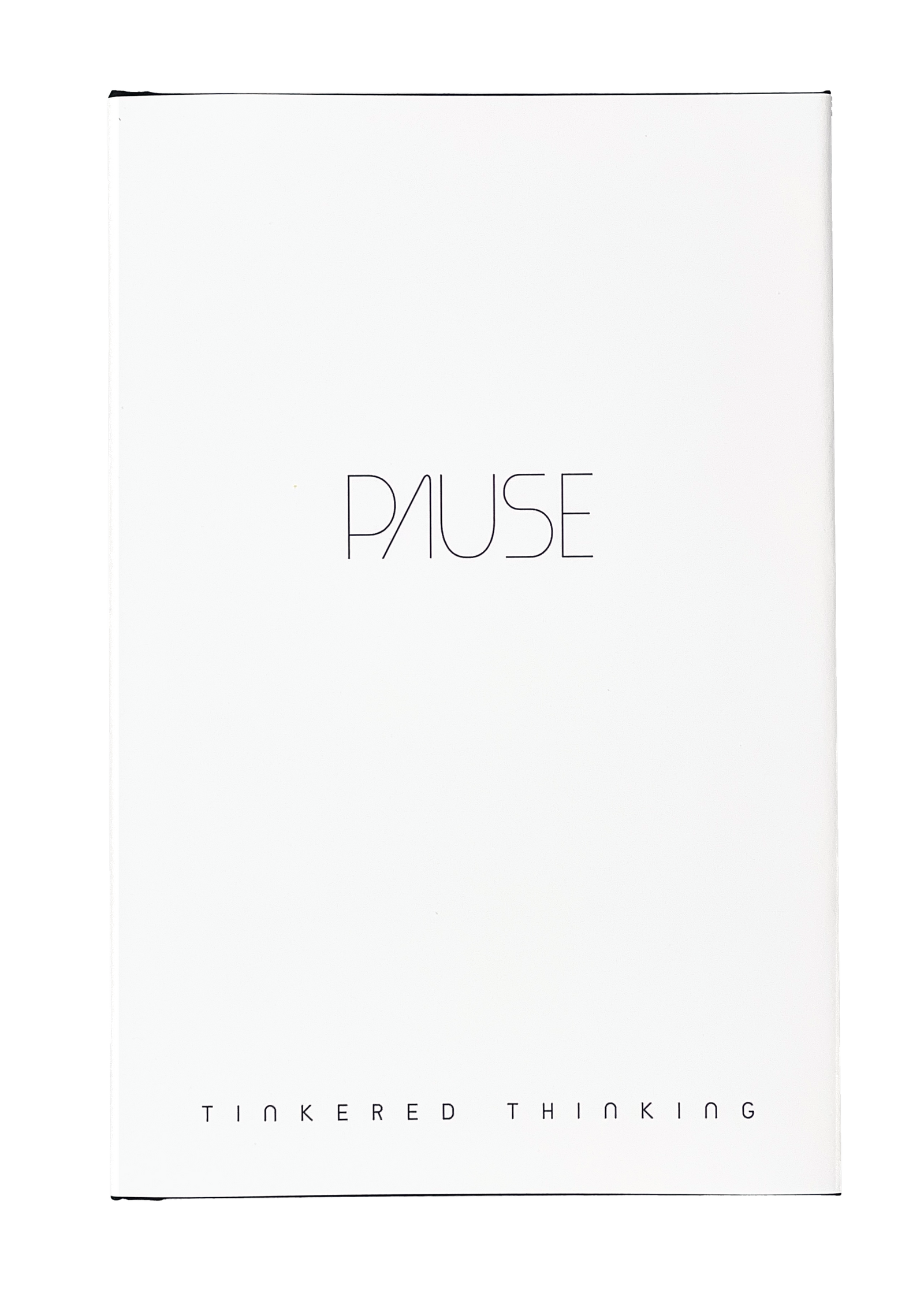
The first non-fiction book from Tinkered Thinking. PAUSE is a short book on meditation. Now available on the Tinkered Thinking Bookstore.
The SECOND illustrated book from Tinkered Thinking is now available!

SPIN CHESS
A Chess app from Tinkered Thinking featuring a variant of chess that bridges all skill levels!

REPAUSE
A meditation app is forthcoming. Stay Tuned.




DOUBLE TIME
November 1st, 2019
Time for a little behind-the-scenes house keeping.
Starting today, Tinkered Thinking is going to embark on another 1-month experiment to create future posts. Two a day, for a month, which will create a month’s worth of episodes in advance.
The purpose of this is more practical than experimental. Technical difficulties with recording equipment have put Tinkered Thinking behind schedule several times, and with no episodes ready in advance, these sorts of problems are very visible.
Not so with some sort of advance.
The experimental part of this is to once again invoke the architecture for installing a new habit. Last time this was attempted, a series of special rewards were planned in accordance with the habit-forming thresholds.
If you haven’t encountered this sort of thing before, it’s well worth the time to repeat it.
For any new habit that we’d like to adopt, the first month is the most difficult. Within that month there are thresholds where things seem to get noticeably easier. These thresholds are 3 days, 7 days, 21 days, 28 days and 30 days. James Clear and Charles Duhigg have written fantastic books about the structure and formation of habits and both authors are highly recommended.
It follows that discipline is only really required to create a habit.
Once the habit has taken root, the behavior is automatic and the arduous experience of willing one’s self to act is no longer necessary.
Discipline is only required for short bursts, when we thirst for a system upgrade.
This is one of the reasons why rewards, or treats planned with each habit threshold during that first month are so effective. We incentivize ourselves towards each one, and in so doing we chunk the month into smaller, more digestible portions that we actually can will ourselves through.
This technique, along with many others that both James Clear and Charles Duhigg examine, are very effective.
It’ll be curious to see how this plays out with the production of advanced episodes. Will two episodes become the norm of production for Tinkered Thinking?
Maybe, maybe not.
We’ll see.

THE REDUNDANCY OF THINKING WITHOUT TINKERING
October 31st, 2019
How many times have you had the same thought?
Naturally, this is an impossible question. Countless thoughts have been repetitively run in the sound booth of our minds.
It’s quite similar to asking: how many times have you made the exact same dumb mistake again?
We are all victim to this repetitive malfunction.
Left to its own devices, the brain is a repetition machine.
The study of habits only exemplifies this. The fact that the brain is a repetition machine is what makes good habits so valuable and easy once installed, and bad habits so insidious and entrenched.
Much of the self-improvement world revolves around the notion of installing good habits and then simply waiting for the results to compound into large, noticeable benefits.
It holds that we are all broken records, and that it’s just a matter of making sure we are singing the right song.
There’s a lot of truth to this.
We may even go so far as to say that all thinking is mere repetition if we are not actively tinkering with the way it works. And if that’s the case, is it even thinking without the tinkering?
One perspective can see that the name tinkered thinking, is a bit redundant: i.e. can we really call it thinking if it’s not actively seeking to evolve some new thoughts?
But take habits -both good and bad- into account and thinking might simply be defined as brain activity.
Tinkering with that activity is how we improve it, switching up habitual patterns and most importantly, making a habit of seeking a better way to think.
This is a process that can be never ending, making life always fresh and full of possibility.
It is the realm of the autodidact, the person who doesn’t simply figure it out, but teaches themselves how to figure it out.
We think of a tinkerer as someone fiddling with some mechanical gadget, like a pocket watch, or an automaton,
but the supreme object of someone who tinkers is their own self.
THE END OF MONEY
October 30th, 2019
In the 1990’s, an anthropologist named Robin Dunbar proposed that humans can only maintain social groups of about 150 individuals. This refers to stable relationships, it does not mean to include any and every acquaintance or simply people we might know about, such as celebrities, which is purely a one-way street.
The number has come under some scrutiny but no one disagrees that the concept is valid and we are certainly limited when it comes to how many people we can know, and that number is somewhere around what Dunbar has proposed.
Dunbar’s number is the result of an innate physical limit on memory. Our brains are only so big. And this limit is the reason why we have developed systems like money.
Since we live in societies that far exceed Dunbar’s number, we need a way to trust strangers. Money fills in this role, and it’s even baked into the words that we use around number.
For example, to have good credit means that you’re likely to be loaned money. The word ‘credit’ means simply ‘belief’. Think of the word incredible. Which means literally, unbelievable.
A credit card is therefore a ‘belief’ card, and if it isn’t declined, the transaction basically implies that a stranger is trusted because they make good on their debts.
Compare this system of money to the way very close friends handle similar ‘transactions’. If for instance, a good friend asks for help, and then offers some sort of payback, it’s far more likely we wave them off and say something like “you would do the same for me.” And indeed, we say it because we know it’s true. This is the nature of friendship, and money is the system that substitutes for friendship when we deal with strangers.
Recent advances in brain interface technology calls all of this into question. One such company, Neuralink has created a system that allows for direct communication between the brain and a computer outside of the skull. There’s an interesting Black Mirror episode that has the same premise.
Now, while the technology is still in early development, it’s conceivable that such a communication can be hooked up to a hard drive of some sort and radically expand the capabilities of our memory.
This might sound like science fiction, but the basic components of this fiction already exist in separate parts. We do have storage devices that can hold enormous quantities of audio, text, and video, and now we have a way for the brain to communicate with computers. The parts of the equation are there and it’s unlikely that industry won’t supply the addition operation to these parts.
Strangely enough, this technological possibility calls into question the use of money.
Imagine this: You have an infinite memory of people. Not only that but you have access to other people’s opinions about people. This might sound like a data breech but we do it all the time. It’s what a resume is, and what’s going on when we call a reference, or when we ask close friends at a party about someone attractive on the other side of the room.
Imagine even further: many researchers, companies and doctors are trying to unlock the mysteries of aging. Radical life extension may or may not be around the corner. Let’s say it is. With enough time, and enough memory, you could get to know. . . everyone.
This might seem like impossible fantasy, but it’s without a doubt that our ancestors from tens of thousands of years ago would think any description of modern day society would likewise be an impossible fantasy.
When we are young and just learning to ride a bike, we have training wheels. And those who can remember the experience, might agree, they don’t do a great job teaching you how to ride with two wheels.
We might say something similar about money. The system of money has all of these unfair loopholes, and the amount of money someone has certainly doesn’t predict how trustworthy they are. In terms of being a substitute for authentic friendship, money works about as well as training wheels do on a bike.
The difference is that a child’s growing brain ultimately gains the capacity to handle balance on a bike, whereas human memory is capped in its capacities and it never expands to accommodate the enormous size of society.
But with technology, it might one day be able to handle this enormous amount of data.
Imagine a day when the use of money becomes irrelevant because the cooperative capacity of each and every person is completely transparent, and the complex network through which we all help each other with our projects is illuminated.
The end of money isn’t even the most radical implication of these possibilities.
Instead of 6-derees of separation between you and everyone else, imagine no degrees of separation. The potential for enhanced efficient cooperation doesn’t just exist on a financial level, but an emotional level.
The greatest possibility of increased time and memory is the chance to get to know our enemies and eventually
to cooperate with them.
This episode relies heavily on Episode 325: Failures of Cooperation. If the idea of money as a substitute for trust sparked your interest then check out Episode 325 which thoroughly explores this idea.
AMENDS
October 29th, 2019
Actions always speak louder than words.
Our language, our speech, the promises we make - all of these are a mere conceptual realm. And as much talking as we do, it’s always action that speaks louder.
One oft-used phrase that we retreat to can be quick to lose it’s meaning:
I’m sorry.
In relationships of all sorts, it’s possible to get stuck in a sort of habit of saying I’m sorry, over and over.
And like anything else repeated, it often loses it’s meaning.
Unless, we act upon it.
The action that corresponds to ‘sorry’ is a little counter-intuitive.
There’s much in western culture and history to push us in a direction of punishment, but punishing one’s self as the action stemming from I’m sorry does not make amends.
The answer is more counter-intuitive.
I’m sorry certainly seeks to clarify something about the past but it has nothing to do with moving forward.
I’m sorry is about the past.
Making amends is about the future.
Making amends requires moving forward with actions that are in line with the ideas we share with the people we care about.
It feels intuitive to say sorry because there’s no action we can take to affect the past. Often it ends here because everything is in the past. But just as we try something different after failing to achieve something, the next step is a creative one.
Making amends is about building a future. Not just merely talking about it or bemoaning the fact that it was thwarted by past mistakes.
It’s a practical exercise as much as it is a healing one.
And this separates it from the usual stereotypical option of flowers, or a gift, which are rarely practical and almost always indulgent in some way.
Looking at the action of making amends as a practical contribution to the future forces it to be considered under a far more thoughtful light.
It’s not just a guideline for making amends, it’s the basis for contributing to the health of any relationship.
PROMISE?
October 28th, 2019
What is a promise?
An agreement between people that seeks to make the future a little more certain. It’s a common idea about how the future is going to look. Or at the very least, it’s a common idea about a future people are going to work to bring about.
Promises are sacred things, they pop up in life in the heart of very important events: marriage, baptisms, court proceedings.
Promises address our deepest concern and our greatest fear, namely chaos. Promises represent a one-way direction away from chaos and towards order.
They can be problematic, in the same way a poor question can lead us in fruitless circles.
An example of such poor questions would be: what’s the meaning of life? This is a terrible question because it’s unanswerable, and at the very least it simply produces anxiety, and at the very most it produces bad philosophy.
Promises that lack a thoughtful and dynamic consideration of the future can be likewise problematic, as so many divorces might attest to.
The problem is that the future is unpredictable, and we often bite off more than we can chew when we make a promise about it. Situations change and people change as a result, and naturally situations change when people do. This is a risky dance, and we often sabotage ourselves by thinking we have more control than we actually do.
This isn’t to say that promises can’t be wonderfully useful, it’s only to say that we need to be careful about the promises we make.
A bad promise kept is worse than a good promise broken.
A bad promise kept perpetuates something rotten through time creating an unwanted future, whereas a good promise broken does not necessarily cancel out the possibility of building that originally envisioned future.
Promises may be more like questions than we might at first realize.
A good question often leads to an even better question.
Does a good promise lead to an even better promise?
Perhaps it helps to remember just what promises are addressing: the future.
Let’s rephrase the question:
Can a good vision for the future lead to an even better vision for the future?
This certainly seems to make sense.
As we move forward productively towards one vision, we inevitably discover things we didn’t expect; this is to be expected considering the unpredictable nature of the future.
Any resourceful person is going to put those unanticipated discoveries to good use, and the leverage of such discoveries can easily make that original idea of the future seem less ambitious as a vision of an even better future emerges.
We might even look at this process as a toggle between promises and questions. As we move forward towards a shared vision, our discoveries might inspire the question: is there something even greater that we can shoot for? Inevitably this spawns more and more questions, and as we slowly answer each one, we update our shared idea of what the future can look like.
The mistake that plagues our promises is that we think of them as static entities. They are solid, which inevitably makes them brittle, and easier to break.
Think about it: what’s easier to break?
A stone,
Or a pool of water.
It’s a trick question of course. How do you break water? We can imagine it frozen, and cracking, just like a rock, but unlike a rock, we can warm those shards, make it all liquid again, put it into the original shape and freeze it. Water is dynamic in a way the stone isn’t.
All this is to say that we make many of our promises as though we are talking about the past. As though we are talking about something that can’t change. But the fact is, when we make a promise we are talking about something that has change at its core.
As we move forward. As we experience more and learn more and understand more. We need to be able to ask: was that the best promise we could make?
Chances are everyone can see something better now.